

Jan Bartek – AncientPages.com – Scientists have analyzed ash residues from ancient incense burners in Pompeii and nearby villas, revealing new insights into Roman trade and religious practices. Thanks to the exceptional preservation caused by the eruption of Mount Vesuvius in 79 AD, ash left on household altars and in ritual vessels has remained intact for nearly two millennia.

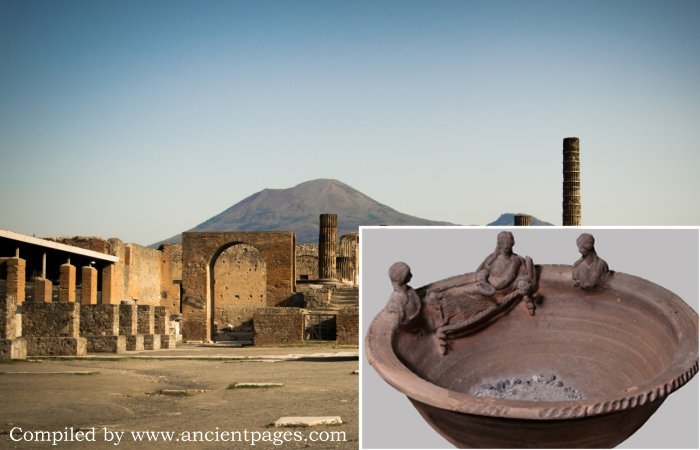
Terracotta incense burner with the investigated ash residues. The rim is adorned with three female figures, probably depicting deceased persons who were venerated after their death. (Image: Parco Archeologico di Pompeii. Fotograf: Johannes Eber)
An international research team from the University of Zurich, LMU, and other partner institutions has, for the first time, scientifically examined what was burned in these Roman incense burners. Using advanced laboratory techniques, they identified not only local plant materials but also imported aromatic substances originating from Africa or Asia.
These findings show that the inhabitants of Pompeii used exotic, long-distance trade goods in their religious rituals. This, in turn, provides strong evidence that Pompeii was integrated into a far-reaching global trade network, connecting the city to distant regions well beyond the Mediterranean.

Pompeian incense burner with the investigated ash residues. (Image: Parco Archeologico di Pompeii. Fotograf: Johannes Eber)
“We can now pinpoint which fragrances were actually burned in Pompeian domestic cult practices,” says Johannes Eber from the University of Zurich, who led the study. “Alongside regional plants, we found traces of imported resins – an indicator of Pompeii’s far-reaching trade connections.” Particularly notable: In one vessel, the researchers identified residues from an exotic tree resin that probably comes from tropical regions of Africa or Asia.
“Molecular analyses also point to a grape product in one of the incense burners,” says Maxime Rageot from the University of Bonn, who carried out the biomolecular investigations for the study.
“This would be consistent with the use of wine in rituals as portrayed in Roman imagery and described in texts. At the same time, it demonstrates the importance of supplementing archaeological studies with scientific analyses,” observes Rageot.

Pompeian street altar with painted images of gods and ash residues from the last sacrifice performed there. Photo from 1915. (Image: Parco Archeologico di Pompeii. Archivio Fotografico Inv. C756)
“The combination of various cutting-edge chemical and microscopic investigation techniques makes the everyday religious practices of the people in Pompeii suddenly tangible,” explains LMU archaeologist Philipp W. Stockhammer, whose ERC research group initiated the study.
Far-Reaching Trade Network Almost 2,000 Years Ago
Pompeii Archeological Park, which recently established a new permanent exhibition about the eruption and its victims, in which it presents a large number of organic finds such as plant residues, foods, and wooden objects, underscores the importance of these kinds of studies: “Without Pompeii, our knowledge of the Roman world would be poorer,” says director of the park, Gabriel Zuchtriegel.
See also: More Archaeology News
“Yet it holds a wealth of data and insights that only contemporary archaeological practices can properly access. Thanks to interdisciplinary collaboration with other sciences, we can still discover many things about life in the ancient city.”

Forum of Pompeii. View north of Temple of Jupiter and Vesuvius. (Image: Parco Archeologico di Pompeii. Fotograf: Johannes Eber)
The investigation reveals that Pompeii was more than a Roman city near Mount Vesuvius; it was integrated into a far-reaching global trade network. Evidence of this extensive connectivity can be detected even in the scents and substances used on their household altars, which reflect goods and influences arriving from distant regions.
Source: Universität Zürich
Written by Jan Bartek – AncientPages.com Staff Writer


Recent Comments